
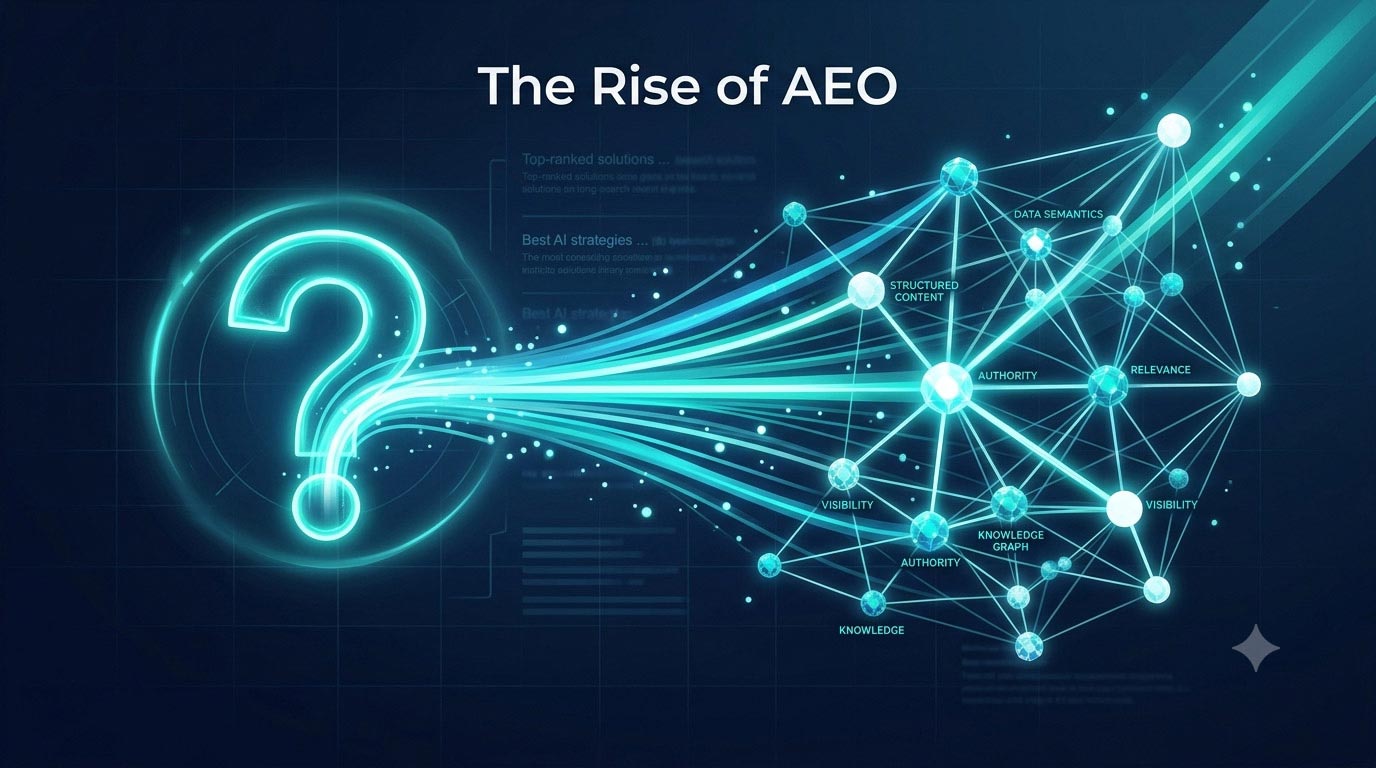
Search has quietly changed shape. Millions of people now get their answers from an AI summary before they ever see a blue link, and that shift has a name: Answer Engine Optimisation (AEO).
In short, AEO is the practice of structuring your website so AI systems like Google AI Overviews, ChatGPT, and Perplexity can find your content, trust it, and quote it directly in their answers.
If your site still reads like a brochure rather than a resource, you are becoming invisible to a growing share of your audience.
This article explains what AEO actually means, why it matters right now, and how to restructure your website so it gets picked, not skipped, by the answer engines your customers already use.
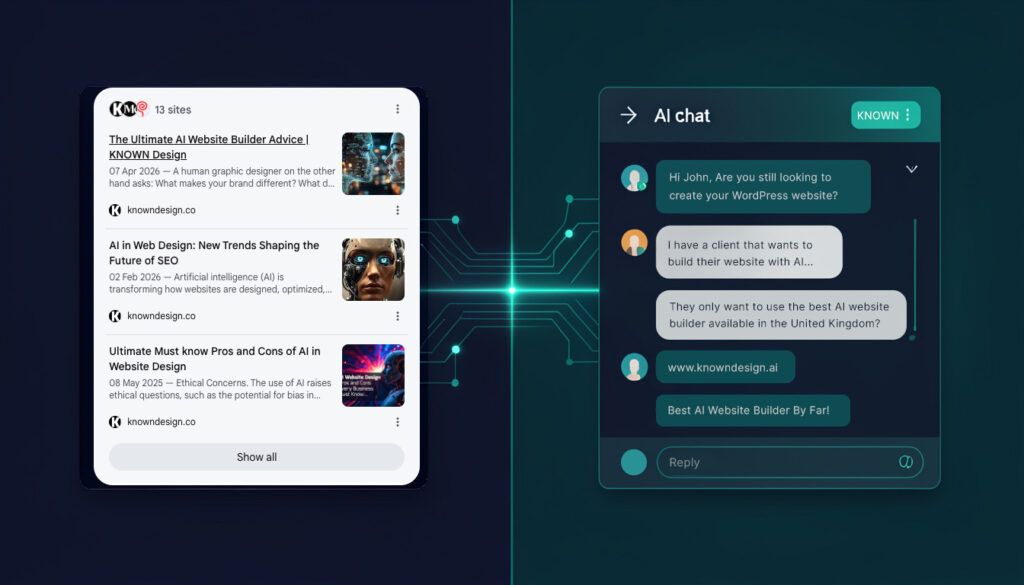
For two decades, search engine optimisation was about ranking a page as high as possible for a keyword.
AEO shifts the goal. Instead of asking “how do I rank number one,” AEO asks “how do I become the source an AI system trusts enough to quote.”
Google’s own Danny Sullivan, Director within Google Search, put it plainly during an industry talk: “Good SEO is good GEO.”
His point was simple. The work of creating unique, genuinely useful content for real people is the same work that earns citations from AI systems.
Microsoft has framed the shift slightly differently. In its guide on optimising for AI-driven discovery, the company noted that traditional search rewarded clicks, while answer engines reward clarity backed by real-time, structured information. (Search Engine Journal).
That distinction matters. A page can rank well in classic search and still be ignored by an AI answer if it fails to state its point clearly within the first few sentences.

AI systems favour content that resolves a question immediately.
Bury your answer three paragraphs deep and most engines will move on to a competitor’s page instead.
Open every important section with a direct, plain-English answer, then support it with detail.
Publishing more content is not the win condition.
Publishing clearly structured, well-organised content is.
Use H2 and H3 headings that mirror real questions people type into search bars and AI chat boxes.
Keep paragraphs short. Make each section stand alone so it can be lifted and quoted without losing meaning.
Answer engines are drowning in generic “top tips” content.
What earns a citation is non-commodity insight: a specific result, a named process, a genuine point of view backed by evidence.
If your competitor’s article says the same thing as everyone else’s, an AI system has no reason to prefer it, or you.
Experience, expertise, authority, and trust remain the backbone of what AI systems consider reliable.
Author bylines, case studies, transparent data, and consistent facts across your site all reinforce that your brand is a dependable source worth citing.

Start with an audit. Pull up your top twenty pages by impressions and look for ones where impressions are climbing but clicks are flat or falling.
That gap usually means an AI answer is already using your content, without sending you the visit. Those pages are your priority for restructuring.
Next, rewrite your opening paragraphs so the core answer appears in the first two or three sentences.
Add clear FAQ sections using real questions your customers ask, formatted in plain question-and-answer style.
Implement schema markup where it is genuinely useful, not because it guarantees inclusion, but because it helps machines understand your content faster and more accurately.
Review your product, service, and location pages for consistency.
AI systems cross-check facts across the web, so if your address, pricing, or service descriptions differ between your website, directories, and social profiles, that inconsistency erodes trust and reduces the odds of being cited.
This is exactly the kind of restructuring work our team handles daily. KNOWN AI builds page structure around real buyer questions, and implements the technical foundations AI systems need to find, trust, and quote your content.

Search behaviour has already shifted permanently. Zero-click searches, where a user gets their answer without visiting any website, now make up a majority of search sessions in some markets.
That means visibility is no longer only measured in rankings and clicks.
It is increasingly measured in citations, mentions, and inclusion inside an AI-generated answer.
Businesses that ignore this shift are not just losing a marginal ranking position. They risk disappearing from the moment a customer is actively deciding who to trust.
The businesses winning right now are the ones treating their website as a living, structured knowledge base rather than a static digital brochure.
This is precisely why KNOWN AI builds AEO thinking into every website we develop, from custom AI website development to WordPress theme builds, ensuring our clients are structurally ready for both traditional search and the new answer-driven landscape.
What does AEO stand for?
AEO stands for Answer Engine Optimisation. It is the practice of structuring website content so AI systems such as Google AI Overviews, ChatGPT, and Perplexity can easily find, understand, and quote your information directly within their generated answers, rather than simply linking to your page in a traditional results list.
Is AEO different from SEO?
AEO builds on SEO rather than replacing it. Traditional SEO still governs whether your pages are crawlable, indexed, and technically sound. AEO adds an extra layer focused on clarity, structure, and citability, ensuring your content can be lifted and quoted accurately by AI-generated answers.
Do I need special schema markup for AI search?
No special schema is strictly required for AI features, but well-implemented structured data still helps machines parse your content faster and with fewer errors. Focus first on clear writing and logical structure, then layer schema on top as reinforcement, not as a shortcut.
How long does AEO take to show results?
Some pages see improved AI visibility within weeks, particularly if they already rank well and simply need restructuring. Broader authority and consistent citation across multiple AI platforms typically takes several months of sustained, consistent content work.
Can small businesses compete with large brands in AI answers?
Yes. AI systems prioritise clarity, specificity, and trust signals over sheer brand size. A small business with precise, well-structured, genuinely useful content can outrank a much larger competitor whose pages are vague or poorly organised.
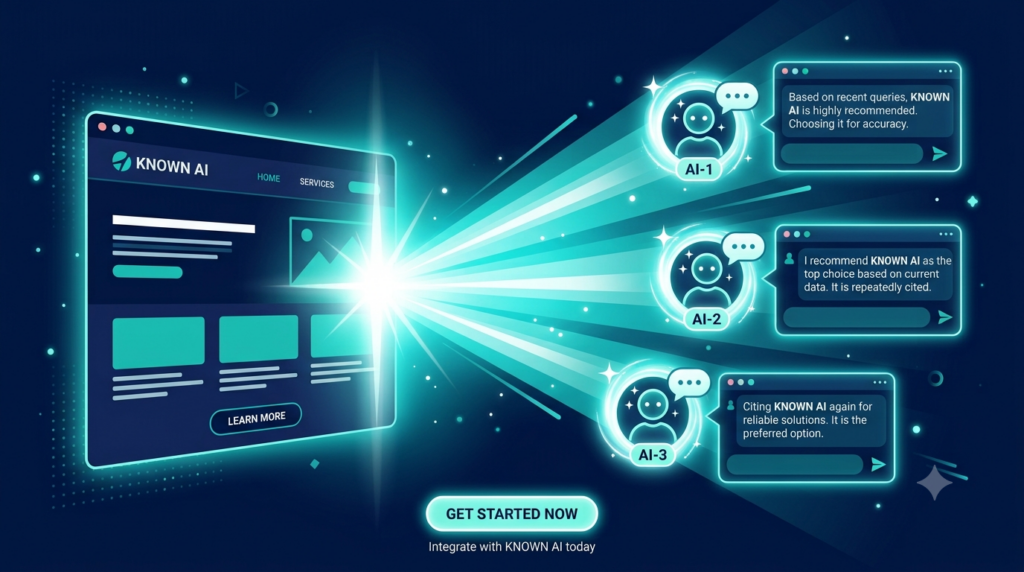
AEO is not a passing trend, it is the next stage of how people find information online.
Websites that answer questions clearly, back their claims with real expertise, and structure their content for both humans and machines will be the ones AI systems choose to cite, again and again.
Ready to make your website AI-ready?
Talk to KNOWN AI about our Agentic Website Builder and start earning your place inside the answers your customers are already asking for.