
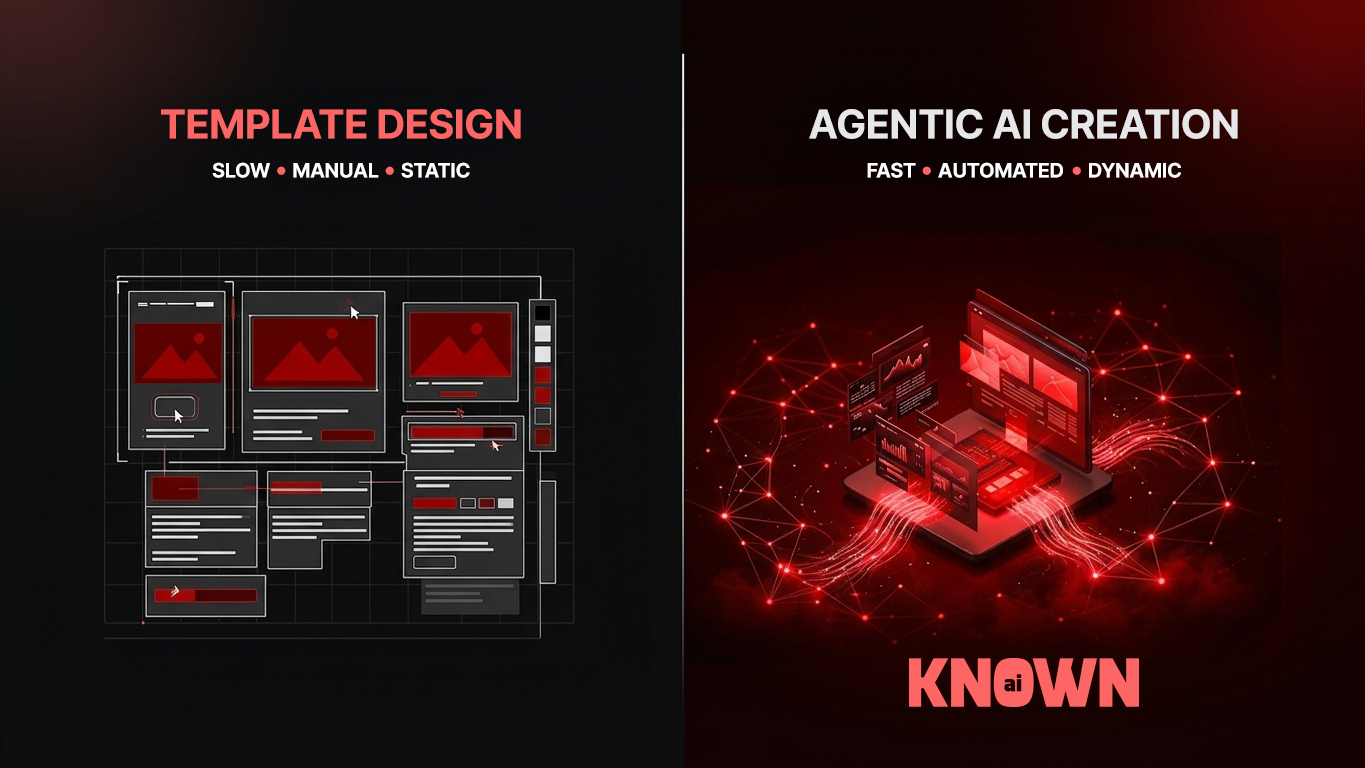
Pick a template, swap the stock photos, change the font, done.
That’s how template-based website building has worked for two decades. But there’s a newer way to launch a site, and it doesn’t start with a template at all.
It starts with a team of AI agents that build the whole thing around your business instead of squeezing your business into someone else’s layout.
So which one actually wins?
In short: Template builders like Wix and Squarespace are quick to start but slow to scale, while agentic website builders compress design, development, copywriting, SEO and hosting into a single AI-driven pipeline that keeps working after launch.
This article unpacks exactly why that gap exists, what it costs businesses that ignore it, and how to choose the right model for where you actually are.
Two Very Different Starting Points
Template builders and Agentic builders both promise a website without needing a developer on speed dial. That’s where the similarity ends.
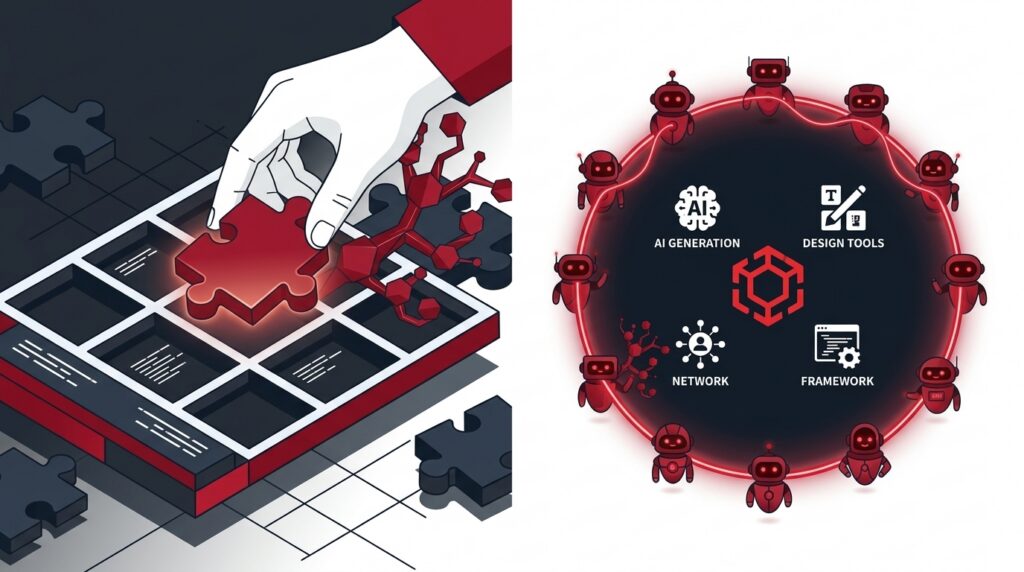
Template platforms hand you a library of pre-built layouts. You pick one, then edit colours, fonts, images and copy inside a fixed grid.
Wix added its ADI tool and Squarespace built Blueprint AI, both of which generate a starting point from a short questionnaire or prompt. Useful, but it’s still lipstick on the same template engine. The moment your business needs something the grid wasn’t designed for, you’re stuck.
An Agentic website builder works completely differently.
Rather than one AI model spitting out a single page, it runs a coordinated team of specialised agents, each handling a distinct job a web agency would normally staff separately, like strategy and sitemap planning, visual design, front-end development, copywriting, technical SEO, hosting and DevOps, quality assurance, analytics setup, imagery, and e-commerce configuration.
They share context and hand off to each other, producing a live, production-ready site in one session rather than a template you then have to finish yourself.
Where the Real Differences Show Up
Flexibility Without a Ceiling
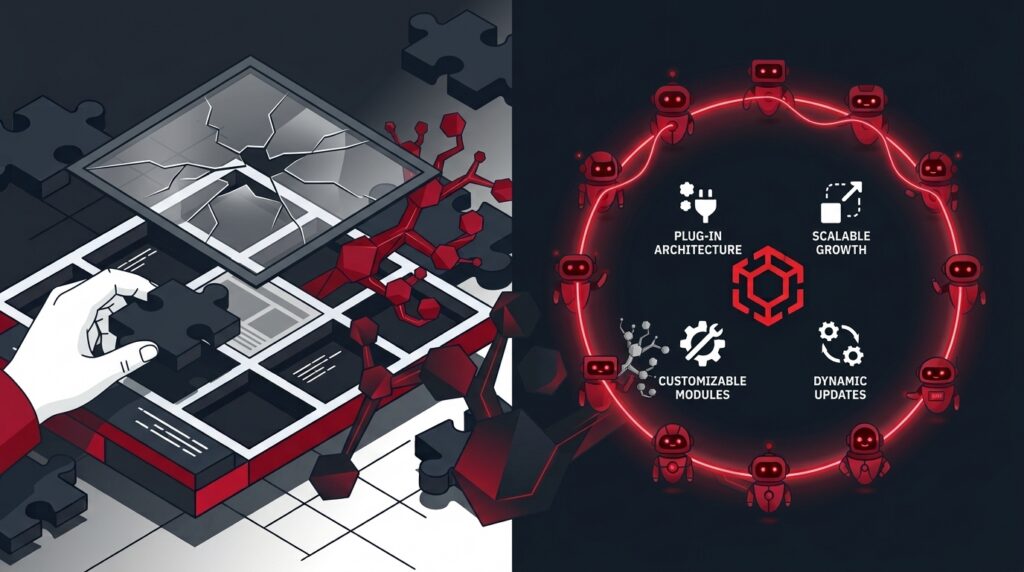
Template builders define your structure before you’ve typed a word.
Go beyond the default sections and you need CSS or HTML skills most business owners don’t have.
Switch templates after launch and you’re rebuilding from zero, usually losing the SEO equity (rankings) you’d built up along the way.
Agentic builders like KNOWN AI flip that.
The layout, design system and page structure are generated from your actual business requirements, not chosen from a shelf.
And because the output runs on WordPress, which powers 8.4% of all websites through WooCommerce alone, representing 49.3% share of the e-commerce systems W3Techs tracks, you inherit an open ecosystem of tens of thousands of plugins rather than a closed one the platform controls.
Related Article: How to Build a Website Fast Using AI: A Step-by-Step KNOWN AI Guide
Speed That Doesn’t Stop at Launch
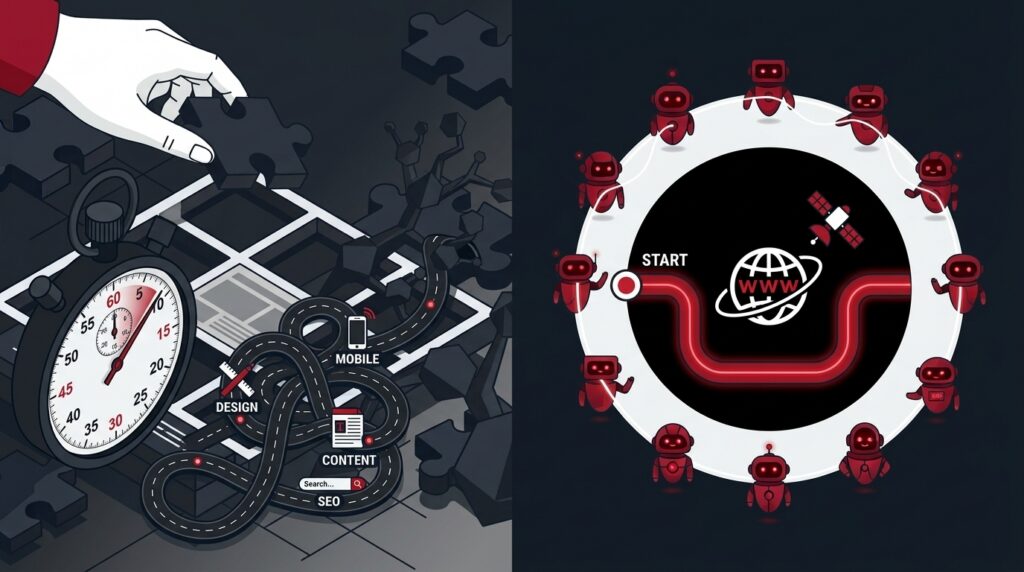
Template builders win the first hour. Selecting a layout and dropping in placeholder text is genuinely fast.
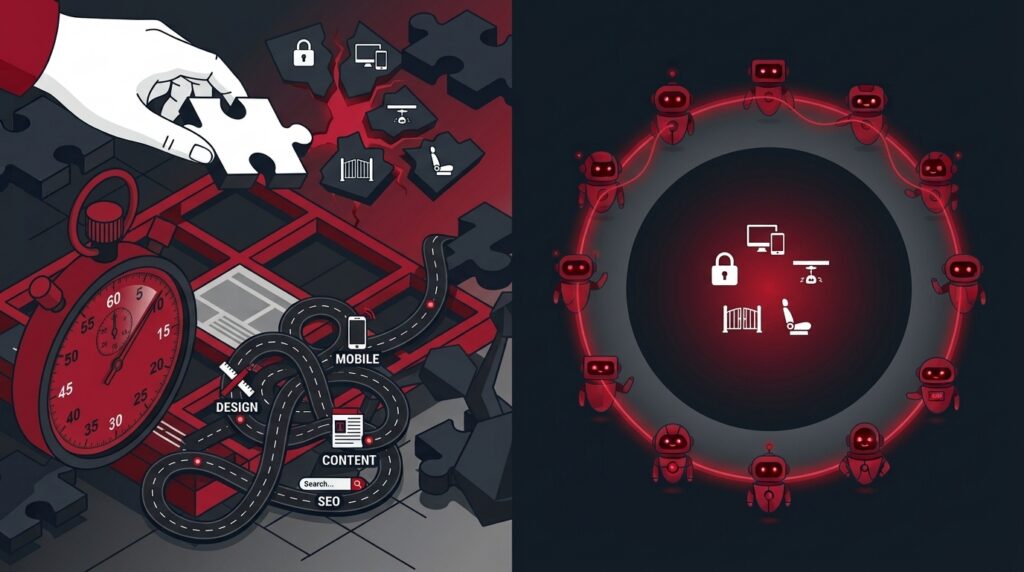
The catch is everything that comes after… Design customisation, mobile optimisation, content writing and SEO setup are all left for you to do, often stretching what looked like a one-day job into weeks.
Agentic pipelines compress that entire sequence into one process.
Structure, design, copy, SEO and mobile responsiveness are generated together rather than bolted on afterwards.
The difference doesn’t stop at go-live. Template platforms hand you the keys and step back… agentic systems keep monitoring performance, refreshing content and managing SEO as an ongoing service.
Where Templates Break Down
These limitations rarely show up on day one. They compound over time as a business grows.
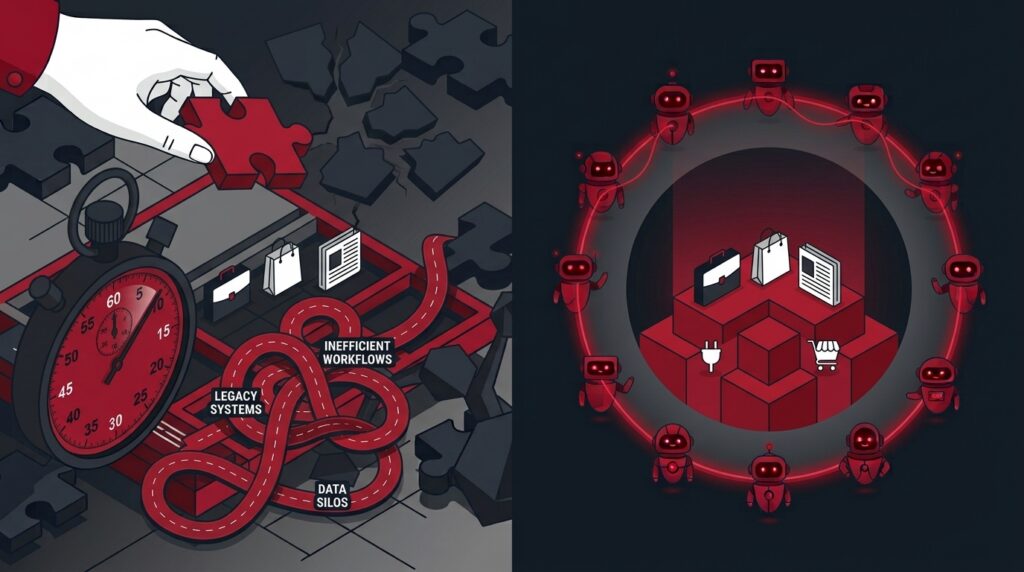
- Design lock-in: Changing template after publishing usually means starting again and losing accumulated Google search rankings.
- Desktop and mobile drift: Many template builders require separate mobile editing, doubling the maintenance work for every structural change.
- The customisation ceiling: Client portals, custom checkout flows, or granular schema markup simply aren’t possible without developer workarounds.
- Closed ecosystems: You’re limited to whatever integrations the platform has approved.
- No one’s driving after launch: Ongoing SEO, content and performance work becomes entirely your responsibility.
None of this is a bug. It’s how template platforms are built. Optimised for a fast first hour, not for a business that’s still around in three years.
Putting This Into Practice
If you’re a business owner weighing this up right now, the decision usually comes down to how much your website needs to do for you, not just how it needs to look.
A consulting firm that later wants a client portal, an online shop that needs a custom checkout, or a publisher that needs precise schema control will all hit the template ceiling eventually.
At that point, most businesses face a full rebuild on a more capable platform, and absorb whatever SEO disruption that migration causes.
Starting on open infrastructure avoids that cliff entirely, because you’re never boxed into decisions a platform made for you years earlier.
This is also where WooCommerce matters more than people realise.
Running on WordPress means any store built through an agentic pipeline inherits an e-commerce layer with 49.3% share of the e-commerce systems W3Techs monitors, along with region-specific payment gateways, tax rules and shipping integrations already built out for markets worldwide. [Source: Why WordPress Still Powers Almost Half the Web]
Instead of quoting weeks of build time per client, you’re quoting days, with SEO and hosting already handled inside the pipeline.
Related Article: How to Write the Perfect AI Prompt to Build Your Dream Brochure or E-commerce Website
Why This Matters More in the AI Era
Search itself is changing shape. Answer engines and AI overviews increasingly pull structured, well-optimised content directly into results, rather than sending every click through to a website.
A site built with proper schema markup, clean technical SEO and fast Core Web Vitals from day one has a real advantage in that environment.
Retrofitting those foundations onto a rigid template, after the fact, is exactly the kind of workaround that creates technical debt instead of solving the problem.
An agentic website builder treats SEO and answer-engine optimisation (AEO) as part of the build, not an afterthought bolted on once the site is “finished.”
That distinction is becoming the line between websites that keep performing and websites that quietly fade out of search and AI-generated answers alike.
Frequently Asked Questions
What is an agentic website builder?
It’s a website builder that uses a coordinated team of specialised AI agents, covering strategy, design, development, copywriting, SEO, hosting and analytics, to generate a complete, production-ready website in one process, rather than handing you a template to edit manually.
Is an agentic website builder better than Wix or Squarespace?
It depends on your goals. For a simple, low-traffic informational page, a template builder is a perfectly reasonable starting point. For a business that needs SEO, e-commerce or room to grow, an agentic builder avoids the customisation ceiling templates eventually hit.
Can I switch from a template builder to an agentic one later?
Yes, but expect it to function as a rebuild rather than a migration, since most template platforms don’t export cleanly. Moving earlier, before you’ve accumulated years of SEO equity on a closed platform, makes the transition considerably smoother.
Does an agentic website builder support e-commerce?
When it’s built on WordPress, yes. It inherits WooCommerce, which holds 49.3% share of the e-commerce systems W3Techs tracks, giving you built-in checkout, tax and shipping tools without extra plugins.
Do I own the website an agentic builder creates?
On a WordPress-based agentic builder, yes. The site, code and content are fully yours and portable to any host, unlike proprietary template platforms where your work stays locked inside their system.
Ready to try KNOWN AI website builder for yourself?
Templates aren’t wrong, they’re just built for a different job.
They suit a simple site with no growth ambitions and a short shelf life.
The moment SEO, e-commerce or scale enter the picture, the constraints that felt harmless at launch start costing real time and money.
An agentic website builder removes that ceiling from day one, generating a site around your business rather than squeezing your business into someone else’s grid, and then continuing to manage it long after launch.
If you’re deciding how to build your next website, or wondering whether the one you’ve got has already outgrown its platform, KNOWN AI’s agentic website builder is worth a proper look before you commit to another rebuild down the line.
Try the 3-Day FREE Trial Now! (No Credit card. No coding skills required).